

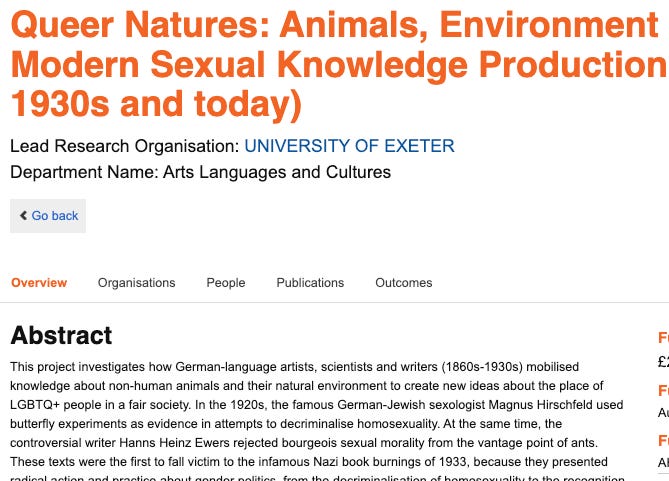
These studies have been added to my growing audit of taxpayer-funded studies. Paid subscribers can access the full list and other resources, such as my list of taxpayer-funded asylum and migration charities.


I have highlighted some of the most ridiculous bits of text in the 10 studies below - the first is one of the worst examples I’ve seen yet!
Situating Pests: Impacts, Disgust, Expertise and Responsibility (SPIDER) (£249,001, Jul 25 - Jul 27)
“Houses in the UK are frequently home to an assortment of unwanted companions, including rats, mice, bedbugs and wasps. Warming temperatures and changing pesticide responses are intensifying these infestations, and there is growing political, legislative, and ethical debate about how they should best be managed. Domestic infestations wreak economic damage and trigger psychological distress, but their effects are unevenly felt, rendering pests not just a public health concern, but also an issue of socio-economic injustice. While costly for some, infestations are lucrative for others, and the professional pest management (PPM) industry is rapidly expanding. Yet despite its significance for public health, its growing economic clout, and the vast scale of the routine animal suffering and death that is integral to its work, the PPM industry is largely absent from social science literature. Particularly lacking are analyses that address the lived impacts of domestic infestations for residents, the embodied expertise of professional pest controllers, and methods which allow researchers to explore the lifeworlds of the pests themselves.”
Urban citizenship and transcontinental lives: Crisis, connection and policy coherence through the lens of ‘Somali Britain’ (£282,635, Jan 26 - Jan 27)
“Recent years have further revealed the depth of inequality in UK cities, including in relation to race and unequal access to the elusive identity of 'Britishness' in the context of polarized attitudes towards migration, asylum and the UK's imperial past. The experience of Somali diaspora - among the UK's most stigmatized and misunderstood but resourceful communities - throws these issues and the broader challenges of post-Brexit, pandemic Britain into sharp relief. The UK Somali experience sits at the intersection of local and global challenges in ways that are emblematic of contemporary questions of race, refuge and unequal citizenship in the context of problematic ideas of 'integration'. Moreover, the lives of UK Somali communities are often highly transcontinental, with patterns of investment and political engagement in the 'homeland', and the reality or aspiration of 'return', shaping their relationship with the UK and the British state.”
Note: “civil society partners” on the study include “the Refugee Council, City of Sanctuary, the Council of Somali Organizations and local Somali community-based organizations in all three cities.”
Making the evidence count: Climate Science in the Courtroom (£251,802, Sept 24 - Sept 27)
“This project will show how climate change attribution science shapes climate litigation through a socio-legal analysis of evidentiary arguments in major influential lawsuits. My findings will support judicial adjudication and the development of effective legal arguments that are grounded in scientific insight. Climate change science is crucial for developing solutions addressing global warming, yet translating scientific climate knowledge into concrete action remains a significant challenge. Litigation has achieved increasing success for demanding climate action from governments and corporations, but academics and legal practitioners have a severely limited understanding of how climate science shapes judicial arguments and outcomes.”
Reimagining Urban Land for Inclusive African Futures (£261,435, Oct 26 - Oct 29)
“South Africa is the world’s most unequal country. Contemporary approaches to land reform and urban planning and development (UDP) have exacerbated spatial segregation and entrenched inequitable access to land. Reliant on frameworks inherited from colonialism, they negate Indigenous epistemologies and continue to treat land as a commodity to fund economic growth. However, land is much more than a commodity; it is a site of security and resilience, a natural resource that sustains livelihoods and ecologies and a source of communal and spiritual identity. This project challenges conventional approaches to valuing and utilising land, proposing a more inclusive, decolonised strategy towards urban planning that is rooted in and reflective of local realties, knowledge and practice.”
A Different Kind of War Story: Centering Love and Care in Peace and Conflict Studies (£279,793, Feb 23 - Feb 27)
“Relations and practices of love and care shape how people make sense of and survive experiences of violence. In the midst and wake of armed conflict, people continue to forge intimate relationships, fall in love, and extend different forms of care to one another. Yet, narratives about armed conflict predominantly focus on harms and suffering. This project asks: How can centering love and care change scholarly and policy understandings of conflict and peace?… This contribution reflects a feminist approach to violence and peace research, which calls for investigating these subjects in ways that go beyond the formal, official actors and actions associated with political violence and peacebuilding. Ethically and methodologically, this project responds to emerging calls for scholars of violence to move beyond damage-centered research in favor of also meaningfully engaging with the forces and relations that sustain life.”
Taxing Ghosts: Closing Residency Loopholes to Fund Post-Pandemic Recovery Efforts (£251,703, Jul 22 - Jul 26)
“This project focuses on the international tax reform agenda that illuminates the systemic problem of ghosting and demonstrates the procedural and substantive reforms needed to address it. The significance of our research lies in our holistic, system-based approach, drawing on research and expertise from law, sociology, international migration studies, and African development studies to examine relevant legal and geo-political factors comprehensively. We will research the national and international factors that facilitate tax ghosting by wealthy individuals and corporations, demonstrate the disparate economic threats created by such tax ghosting, analyze why states have failed to recognize the threats to date, and propose novel yet feasible policy solutions based on our findings.”
Theatre-making in careless times: arts-based approaches to care in Mombasa, Kenya (£249,001, Feb 25 - Feb 27)
“‘No one cares about us – we know our lives are disposable.’ This observation was shared with the PI [Project Lead] by Fatima, a young woman from Mombasa, following a participatory theatre performance about Covid vaccine rumours. Voicing sentiments with global resonance, Fatima’s commentary highlights the profound dearth of care that underpins her reason for refusing vaccination, and that many Mombasans feel in relation to institutional structures at all levels – a lack of care colours engagements with the state, health institutions and development initiatives. Fatima’s words demonstrate how the giving and receiving of care is racialized, classed and gendered (Mahon & Robinson 2011), and evoke the wide-ranging implications that ‘care deficits’ (Hochschild 2003) can have on health, worth and wellbeing.”
Just Futures? An Interdisciplinary Approach to Cultural Climate Models (£273,774, Feb 23 - Jul 26)
“This interdisciplinary project responds to calls for more humanities research on climate change by developing an innovative methodological approach to cultural models of climate futures. It focuses especially on the topic of intergenerational justice. The project group brings together literary studies, linguistics, science and technology studies and literature pedagogy to investigate how different text types - cultural forms such as literature, social media, and literature reception in educational contexts - move between seemingly neutral climate facts ("models of") and normative social values ("models for"). The project is framed by interdisciplinary model theory, which understands models as representations of reality that reduce complexity and serve specific purposes.”
Women online: the impact of VOD on women’s position in the Indian and British film industries (£270,592, Sept 24 - Sept 27)
“Although the number of women working in the cinema in Britain and India has recently increased, in Britain women still represent only 23 percent of film directors; in India the rate of key creative positions held by women is 10 percent. Generally, in both cinemas, women are less paid than their male counterparts. The last decade has seen the exponential rise of video online distribution (VOD) and VOD companies' (VODs) entry into the industry as producers. Corporate VODs like Netflix and Amazon claim to promote women's access to the industry, but these claims remain unsubstantiated. To date no research exists on the impact of VOD on women's access to creative roles, or the percentage of films by women in VODs' libraries. Existing research on women in cinema generally is limited to statistics and individual national cinemas, while research on VOD undertaken so far confines itself to global, corporate VODs.”
Building Lived Experience Accountability into Culturally Competent Health and Well-being Assessment for Trans Youth Social Justice (BLA-HAJ) (£261,548, Jun 24 - Jun 28)
“Efforts are needed to enhance health and well-being amongst trans youth. A shortage of high-quality lived experience informed outcome data impedes effective action in healthcare, education and wider society to safeguard trans youth well-being. Many past approaches to research on trans youth have been culturally incompetent, causing harm and leading to disengagement and distrust of data-oriented activities. Culturally competent approaches, co-developed with trans communities, are critical to enhancing the current evidence-base, and improving policy and practice to better support trans youth.”
BONUS terrible study…
Hematopolitics: Blood Donation and Contested Belonging in East Asia (£201,799, Sept 23 - Aug 26)
“Since the discovery of the life-saving power of blood transfusion, human blood has become an invaluable resource for treatment in modern biomedicine; however, maintaining a steady and safe supply of blood continues to be a challenge in many societies around the world. Even in wealthier countries where the blood-donation rate has been relatively high, new challenges lie ahead as populations age and new infectious diseases like COVID-19 emerge. This research questions how such issues are prompting new understandings of social identity and belonging around blood. Focusing on Japan and South Korea, where blood has strong symbolic power in relation to kinship, nationhood and pollution, I ask how national identity and social relationships are imagined and contested through blood donation.”
For a country three trillion in debt, some individuals in the grant-making arm of this council should be shown the door and the opportunity to find useful employment - elsewhere.