

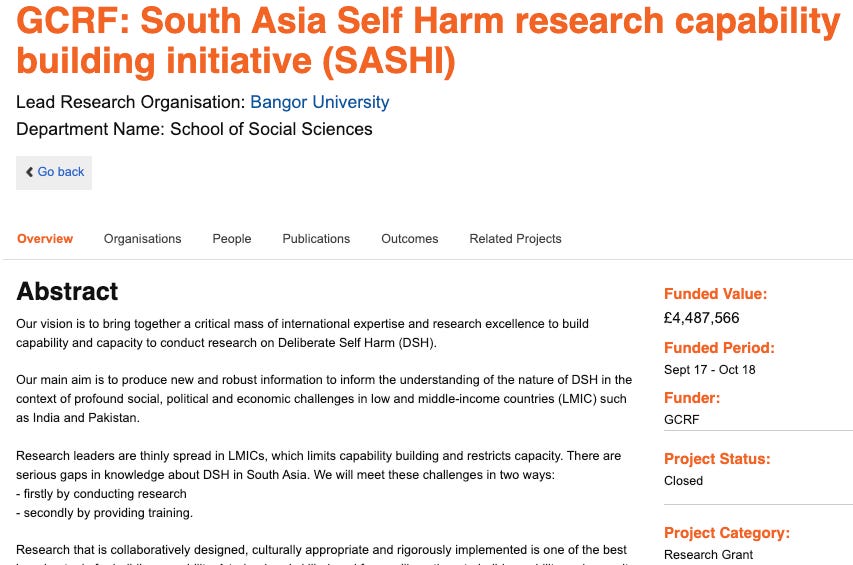
£4,487,566 of the UK foreign aid’s budget was awarded to a study on “Deliberate Self Harm (DSH)” in South Asia, I can reveal.

GCRF: South Asia Self Harm research capability building initiative (SASHI) is a project that took place across two phases at Bangor University and then the University of Manchester (between September 2017 to March 2025).
Its abstract explained…
Our main aim is to produce new and robust information to inform the understanding of the nature of DSH in the context of profound social, political and economic challenges in low and middle-income countries (LMIC) such as India and Pakistan.
… and that:
The work will be of direct relevance to other Low and Middle Income Countries (LMIC) and will also be of interest to people working with minority immigrant communities in the UK and services providing support following an episode of DSH.
Forty eight organisations worked on the research, including British universities and foreign ones, such as Bahria University (based in Islamabad, Pakistan), University of Karachi (Karachi, Pakistan) and Raju Hospital (Chennai, India).
A page about the project, authored by The Centre for Mental Health and Society, reads “We have a growing portfolio of self-harm and suicide prevention research at the Centre for Mental Health and Society. A major focus of the work has been in South Asia.”
Catherine Robinson, who is the lead researcher on the project, worked on another study about self-harm in South Asia (awarded £976,251 from the taxpayer-funded Medical Research Council). Titled A Youth Culturally adapted Manual Assisted Psychological therapy (Y-CMAP) for adolescent Pakistani patients with a recent history of self-harm, its abstract explained:
“There are more than 100,000 acts of self-harm in Pakistan annually. The aim of Y-CMAP is to evaluate the clinical and cost-effectiveness of this culturally adapted psychological therapy in adolescent patients with a history of self-harm. Our study in Karachi determined the effectiveness of a 6-8 session CBT-based intervention (C MAP) in adults who had recently self-harmed.”
Robinson’s grants, listed on her academic profile, include: “Improving assessment and treatment of mental disorder after Deliberate Self Harm in South India, 2015 – 2017”.

The South Asia Self Harm research capability building initiative was funded by the Global Challenges Research Fund (GCRF), which was given £1.5 billion of the UK’s Official Development Assistance (ODA) budget.
The GCRF was designed to “address challenges faced by developing countries”, and counted as part of the UK’s pledge to spend 0.7 percent of gross national income on ODA.
I don’t want to sound terribly mean - I care as much as the next person about alleviating mental illness and psychological suffering - but the UK is not the world’s saviour, and I am not sure why we are funding research on self-harm in South Asia. Let me know your thoughts.
More:


But why .. what criteria are used to hand out these monies? Who benefits from the research … was it high up a list of need?